

It usually starts small.
A pause halfway up the stairs. A tightness that settles once you sit down. Breath that doesn’t return as fast as it used to.
You don’t call it pain. You call it “nothing serious.”
That’s how heart trouble prefers to enter into your life— quietly, and without drama, while you’re busy living.
Don’t let it slip.
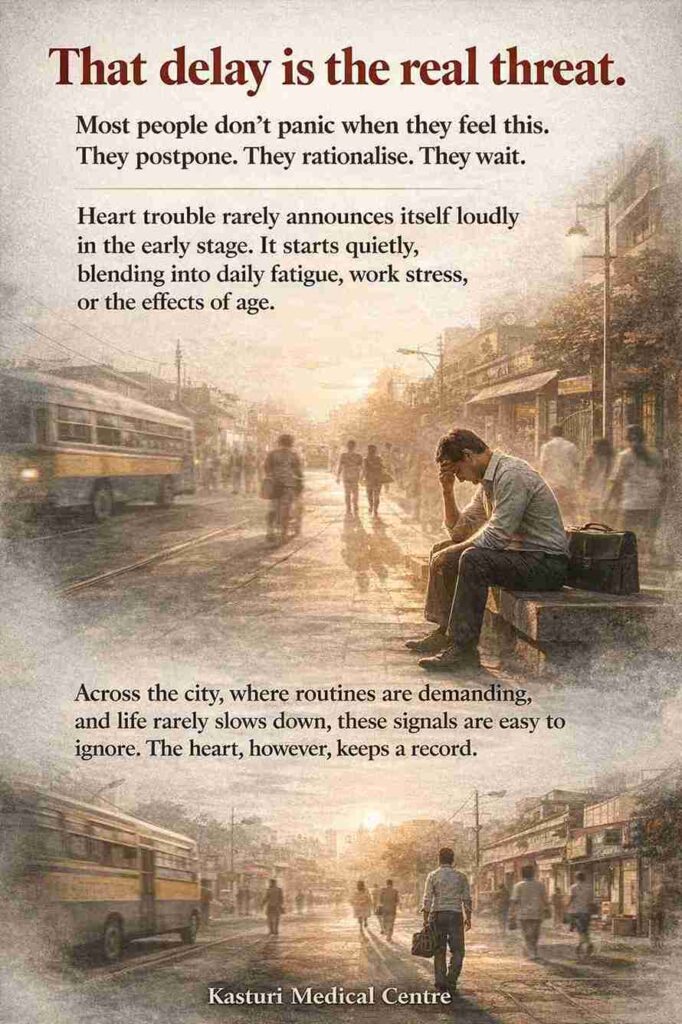
Early intervention can make a huge difference!
At Kasturi Medical Centre, a trusted Superspeciality Hospital in Behala, you can find reliable care and expert guidance.
What doctors actually mean by “early heart trouble”
Early heart trouble refers to subtle changes in heart blood flow or pumping efficiency that cause mild symptoms weeks or months before a major cardiac event.
This stage matters because:
- Damage is often preventable
- Symptoms are usually reversible
- Treatment is simpler and safer
Unfortunately, this is also the phase people dismiss the most.
Why mild chest pain should never be brushed aside
Mild chest pain can indicate reduced blood supply to heart muscles, especially when it appears during exertion, stress, or physical effort.
Chest pain doesn’t always come in the form of sharp agony.
For many people, it shows up as:
- Pressure or tightness rather than pain
- A heavy or squeezed feeling
- Discomfort that settles with rest but returns later
These mild chest pain symptoms are commonly blamed on gas, posture, or exhaustion.
What makes them dangerous is the pattern. Pain linked to activity is never random, even if it feels tolerable.
When breathlessness becomes a heart warning
Breathlessness becomes concerning when it is new, progressive, or disproportionate to physical effort and persists for weeks.
Getting tired happens. Losing breath while doing routine tasks is different.
Watch for:
- Breathlessness while climbing stairs, which you managed easily before
- Fatigue after short walks
- Shortness of breath at night or on waking
This pattern often reflects a shortness of breath, a heart problem, rather than poor fitness or ageing.
Why are these signs commonly ignored in Behala and Joka
This is where reality hits.
People here are conditioned to push through discomfort:
- Long workdays and commutes
- Humidity and heat fatigue
- Family responsibilities that come first
- A mindset of “I’ll deal with it later”
Symptoms don’t stop life in its tracks, so they’re labelled manageable. Over time, this becomes normalised suffering. These are classic early signs of heart disease — subtle enough to ignore, serious enough to matter.
Understanding the real causes behind these early warnings
Knowing the causes of breathlessness and chest pain removes fear and denial.
Common heart-related causes include:
- Reduced oxygen delivery to the heart muscles
- Early stiffness of the heart walls affects pumping
- Inefficient circulation during exertion
These don’t cause constant pain. They cause limits. Reduced stamina. Faster exhaustion. Repeated discomfort that people learn to live with — until they shouldn’t.
Can mild chest pain be heart-related even if tests were normal earlier?
Yes. Early heart issues can be intermittent, meaning symptoms may appear even when previous tests were normal. This is a crucial point that people misunderstand.
Heart conditions don’t always progress in a straight line.
Early-stage changes can:
- Appear under stress or exertion
- Settle temporarily
- Worsen gradually over months.
A “normal” test from last year does not rule out present-day changes. That’s why new or recurring symptoms always deserve reassessment, not reassurance based on old reports.
What happens if these early signs are ignored
Ignoring early heart symptoms can lead to a gradual progression from strain to permanent damage over months.
Delayed care often leads to:
- More frequent symptom episodes
- Reduced physical tolerance
- Higher complication risk
- Longer recovery timelines
The tragedy isn’t a sudden collapse. It’s the missed opportunity to act early.
Why timing matters more than how strong the pain feels
People wait for “serious” pain. That thinking is flawed.
| Acting Early | Acting Late |
| Clear answers | Lingering uncertainty |
| Preventive care | Damage control |
| Faster recovery | Prolonged treatment |
| Lower risk | Higher complications |
Access to a superspeciality hospital in Behala matters most at this early stage, when intervention can still change the story.
How doctors evaluate early heart symptoms
There is no guesswork involved.
Evaluation usually focuses on:
- Symptom patterns over time
- Activity tolerance changes
- Basic heart function and blood flow tests
When done early, these assessments are non-invasive and clarifying. When delayed, they become reactive and complex.
Why treatment works best when started early
Early-stage heart issues respond best to timely treatment that prevents progression and avoids emergencies.
Early intervention can:
- Prevent hospitalisation
- Reduce long-term medication burden
- Avoid invasive procedures
This structured approach is standard at a superspeciality hospital in Behala, where mild symptoms are taken seriously rather than dismissed.
Who should be extra cautious — even without severe pain
You don’t need dramatic symptoms to be at risk.
| Risk Factor | Why It Matters |
| Sedentary routine | Reduces heart adaptability |
| High stress | Increases heart workload |
| Family history | Lowers symptom threshold |
| Long work hours | Masks warning signs |
If symptoms exist alongside these factors, waiting offers no benefit.
Why proximity to specialised care changes decisions
Distance creates hesitation. Convenience enables action.
When an evaluation is nearby, people act sooner. That’s why access to a superspeciality hospital in Behala isn’t about promotion — it’s about removing friction from decision-making.
The quiet cost of postponement
Most heart emergencies were not sudden. They were delayed decisions repeated over weeks and months.
People rarely regret checking early. They almost always regret waiting.
A note on approach and trust
At Kasturi Medical Centre, early cardiac symptoms are handled through careful listening, structured evaluation, and clear explanations. No panic. No dismissal. Just timely clarity.
That balance matters when symptoms feel “not serious enough.”
One last perspective worth sitting with
| Symptom Duration | Medical Meaning |
| A few days | Often manageable |
| Several weeks | Needs evaluation |
| Months | Higher-risk stage |
If your symptoms have crossed days into weeks, delay adds nothing.
The question you keep circling for many at night
“Am I overreacting?”
Overthinking does not damage hearts. Ignoring signals does.
If mild chest discomfort or breathlessness keeps returning, clarity is the smartest move you can make.
A superspeciality hospital in Behala exists for exactly this moment — before emergencies, before regret.
People Also Ask
Can stress alone cause chest pain and breathlessness without heart disease?
Stress can trigger chest tightness and shortness of breath, but it often mimics heart-related symptoms. The problem is overlap. Stress can also worsen underlying heart strain. That’s why persistent or recurring symptoms should never be attributed to stress without proper evaluation.
Is chest pain after eating always due to acid reflux, or can it be heart-related?
Acidity-related pain usually burns and improves with antacids. Heart-related discomfort often feels like pressure or heaviness and may worsen with activity. When symptoms repeat or feel unfamiliar, it’s unsafe to assume digestion is the cause.
Can young or middle-aged adults have early heart problems?
Yes. Early heart issues are increasingly seen in people under 50, especially with stress, sedentary routines, smoking, or family history. Age reduces risk—but never eliminates it.
Do heart symptoms always show up clearly on an ECG?
Not always. Early-stage heart problems can be intermittent and may not appear on a resting ECG. Doctors often rely on symptom patterns and, when needed, additional tests.
Should I wait to see if the symptoms worsen before consulting?
Waiting doesn’t add clarity—it adds risk. Early consultation is meant to rule out problems or catch them early, not confirm the worst.