

Caring for elderly parents with multiple illnesses isn’t just about treatment; it’s about coordination, safety, and quick decisions. An NABH-accredited setup ensures standardised protocols, better monitoring, and fewer medical gaps. When multiple conditions interact, systems matter more than individual care.
Fortunately, Kasturi Medical Centre, a noteworthy NABH-accredited hospital in Kolkata, provides world-class medical care to support the spiritual well-being of local patients and the community.
As families navigate complex care decisions, today’s blog will break down what truly makes care safer and smarter.
Why caring for elderly parents with multiple health conditions gets complicated fast
Elderly patients rarely have a single illness. Diabetes, BP, heart disease, arthritis, and cognitive decline often coexist, making diagnosis, treatment, and monitoring interdependent. ]
A small issue can destabilise sugar levels, BP, and cardiac health simultaneously and trigger multiple complications.
Careful coordination across specialities to prevent rapid deterioration becomes paramount.
This is where a multispeciality hospital like Kasturi Medical Centre becomes critical for senior citizens.
What makes senior citizens with diabetes, BP, heart disease, arthritis, or memory issues more vulnerable?

Senior citizens with diabetes, arthritis, memory issues, BP or heart disease are more vulnerable. Ageing reduces physiological reserves, slowing recovery and increasing the likelihood of complications. Chronic diseases interact, medications overlap, and symptoms often present atypically.
All these increase the risk of delayed diagnosis, treatment errors, and sudden deterioration when proper monitoring systems are absent.
Why one symptom can affect several conditions at once
In elderly patients, a single symptom often overlaps with multiple diseases. Breathlessness, fatigue, or confusion may signal heart, lung, or metabolic issues, making diagnosis complex and requiring coordinated, system-based evaluation.
Without integrated evaluation, treating one issue may worsen another, especially in patients with multiple chronic conditions.
How polypharmacy, falls, and delayed treatment increase risk
- Concurrent use of multiple medications (polypharmacy) increases the risk of drug interactions and side effects.
- Falls can lead to fractures or internal complications.
- Delayed treatment (even by hours) can escalate minor issues into emergencies
That’s why structured medication management is mandatory for elderly patients.
What does NABH accreditation actually mean in a hospital setting?
The National Accreditation Board for Hospitals & Healthcare Providers (NABH) ensures hospitals follow strict standards for patient safety, hygiene, documentation, and clinical protocols.
It reflects a system-driven approach in which care is monitored, audited, and continuously improved to achieve better outcomes.
How NABH standards focus on patient safety, hygiene, and accountability
NABH standardised infection control, patient identification systems, and clinical audits reduce medical errors. These systems define a patient-focused environment where every step is tracked and validated.
Why credentialed staff and standard protocols matter more than families realise
Qualified staff and protocol-based care reduce treatment variability. This ensures consistent decision-making, especially during emergencies, which is crucial in an ICU and emergency hospital setup.
Why an NABH-accredited multispeciality hospital can be safer for elderly parents with multiple conditions
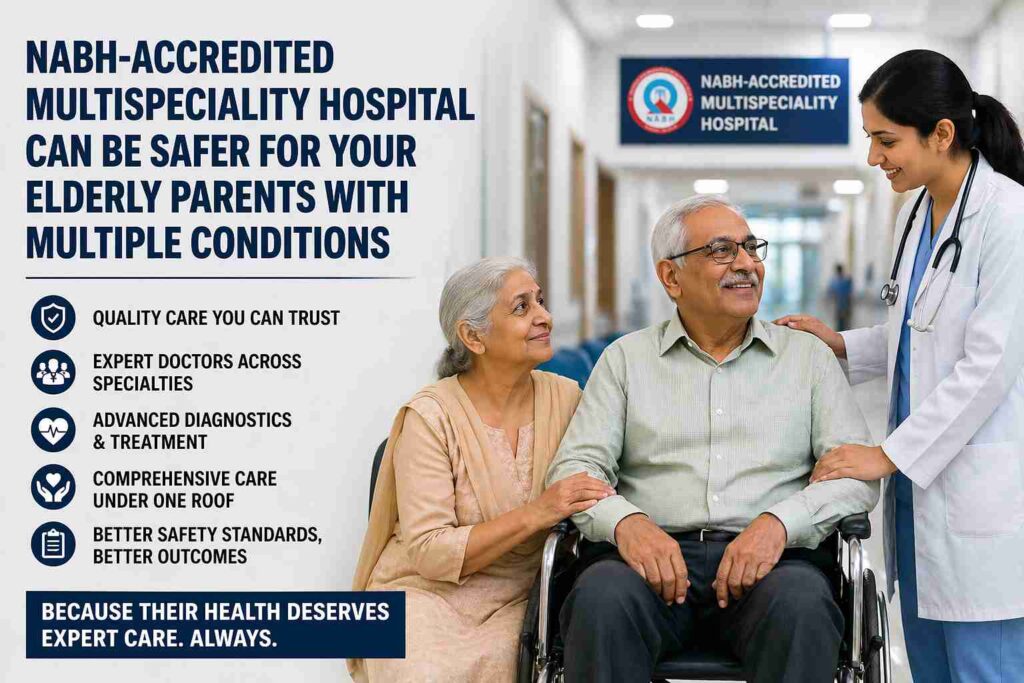
An NABH hospital ensures coordinated care, faster diagnosis, safer medication use, and immediate emergency response. For elderly patients, this significantly reduces complications and improves recovery outcomes.
Better coordination between specialists under one roof
Cardiologists, physicians, and neurologists collaborate rather than work in isolation, ensuring aligned treatment plans.
Safer medication management for patients taking multiple medicines
Cross-checking prescriptions reduces drug interactions and side effects, critical for elderly patients with multiple prescriptions.
Stronger infection control and hygiene practices
Strict infection control protocols, regular sanitisation, and monitored hygiene practices reduce hospital-acquired infections. These protect elderly patients with low immunity from complications, prolonged stays, and life-threatening infections.
Faster emergency response when a senior patient suddenly worsens
Immediate access to specialists offering emergency care for seniors ensures critical time is not lost during sudden deterioration.
How multidisciplinary care helps when elderly patients do not have just one disease
Multidisciplinary care aligns specialists to manage coexisting diseases, reducing treatment conflicts, improving diagnostic accuracy, and ensuring safer, coordinated decisions for elderly patients with multiple chronic conditions.
Cardiology, nephrology, neurology, orthopaedics, and general medicine are working together
A combined approach ensures that every condition is managed without compromising the others, especially in a geriatric medicine hospital setting.
Why repeated referrals and disconnected treatment plans can be risky
Repeated referrals fragment care, delay decisions, and increase miscommunication and treatment overlaps.
Disconnected treatment plans can lead to conflicting prescriptions, missed warning signs, and higher complication risks, especially in a hospital for elderly patients with multiple conditions.
What families should look for when choosing a hospital for ageing parents in Kolkata?
Families should prioritise infrastructure, emergency readiness, multidisciplinary access, and communication systems to ensure safe and efficient care.
Emergency support, ICU backup, diagnostics, and rehabilitation access
A reliable elderly care hospital must have:
- 24/7 emergency services
- ICU availability
- In-house diagnostics
- Rehab and physiotherapy
Clear communication, consent, discharge planning, and family involvement
In a senior citizen care setup, clear communication ensures families understand treatment decisions, consent processes, and risks.
Structured discharge planning and active family involvement improve continuity of care, medication adherence, and recovery outcomes for elderly patients.
When an elderly parent should not rely only on scattered clinic visits anymore
When health becomes unpredictable, scattered clinic visits fall short. Frequent symptoms, changing medications, or repeated issues signal the need for coordinated, hospital-based care to manage conditions safely and consistently, rather than isolated consultations.
Frequent hospitalisations, repeated infections, falls, or changing medicines
Frequent hospitalisations, repeated infections, falls, or constantly changing medicines indicate unstable health, subpar chronic disease management, and higher complication risk.
Warning signs that coordinated hospital-based care may be the safer move
| Warning Sign | What It Means |
| Frequent falls | Mobility decline |
| Multiple prescriptions | Risk of drug interaction |
| Repeated infections | Weak immunity |
NABH hospital vs non-standardised care setting: what changes for the family?
In an NABH-accredited hospital, families experience structured care, clear communication, and standard protocols.
On the other hand, in non-standardised settings, confusion, delays, inconsistent treatment, and higher risks during emergencies and admissions are common.
Less confusion, better documentation, and smoother handovers
Clear protocols reduce confusion, ensure accurate records, and enable smooth handovers between teams. This helps maintain continuity of care without repetition or missing data, keeping families informed throughout treatment and transitions.
Why standard processes matter during emergencies and admissions
Standard processes enable faster response, clear decision-making, and coordinated action during emergencies and admissions. They reduce delays, prevent errors, and ensure coordinated, safe care for elderly patients during emergencies and admissions.
Choosing the right NABH-accredited hospital in Kolkata for elderly parents
Look for these
- Multidisciplinary availability
- ICU and emergency readiness
- Medication safety systems
- Infection control
- Geriatric-focused care
Questions to ask before admission or planned treatment
- Is there multidisciplinary coordination?
- Are emergency services available 24/7?
- How is medication monitored?
What to check beyond the hospital’s website or brochure
Look for real patient outcomes, real testimonials, recent case studies, 24/7 medical support, and world-class facilities.
Kasturi Medical Centre has been a NABL and NABH-accredited premier superspeciality hospital, providing medical care to patients with diverse medical needs.
Final Takeaway: For elderly parents with multiple conditions, safety depends on systems, not just specialists
When elderly parents have multiple conditions, care must be structured, not scattered. From medication safety to emergency readiness, systems decide outcomes. Choosing a NABH-accredited hospital reduces risks, ensures a faster response, and supports better recovery.
Kasturi Medical Centre stands out among local patients as a trusted destination for specialised GI care across Joka, Behala, and South Kolkata.
Reach out to us for your treatment needs.
People also ask
Is an NABH hospital better for senior citizens?
Yes. It ensures strict safety protocols, structured care pathways, and continuous monitoring, reducing medical errors and improving outcomes for elderly patients.
Why do elderly patients with multiple diseases need multispecialty care?
Simply, because conditions overlap and affect each other. Coordinated care across specialities prevents treatment conflicts and ensures safer, more accurate disease management.
What are the benefits of NABH accreditation for patients?
Benefits of NABH accreditation for patients include standardised protocols, enhanced hygiene, greater accountability, and improved patient safety, leading to consistent, reliable care and fewer complications during treatment.
How to choose a safe hospital in Kolkata for my elderly parents?
Choose a hospital with NABH accreditation, strong emergency and ICU support, multidisciplinary care, and clear communication systems for safer, coordinated treatment.