

A sudden burning itch on your palm. Then tiny, fluid-filled blisters appear — often out of nowhere. It is uncomfortable, confusing, and easy to dismiss as "some allergic reaction."
But if this keeps coming back, there is a name for it. There is a reason for it. And there is a way to manage it.
This blog is built specifically for people who keep experiencing this problem and want real answers — not just a list of symptoms. We focus on what is actually causing those blisters and what you should do next.
What Is This Condition? A Simple Definition
Those deep-seated, fluid-filled blisters on your palms or the sides of your fingers are most likely dyshidrotic eczema — also called pompholyx or dyshidrosis.
It is a specific type of eczema that targets the hands and, occasionally, the soles of the feet. The blisters look like tiny "tapioca pearls" sitting just beneath the skin surface. They itch intensely, sometimes burn, and follow a predictable cycle:
| Stage | What Happens | Timeframe |
|---|---|---|
| Prodrome | Burning or tingling sensation under the skin | Days 1–2 |
| Blister formation | Deep, clustered vesicles appear | Days 2–7 |
| Rupture and weeping | Blisters burst, releasing clear fluid | Week 1–2 |
| Peeling and cracking | Skin dries out and may crack painfully | Week 2–4 |
A typical episode lasts 2 to 4 weeks. The problem is — it tends to come back.
"Dyshidrotic eczema is one of the most underdiagnosed hand conditions we see. Patients often treat it as a simple allergy for months before getting a proper diagnosis." — Dr. Mark Herron, Consultant Dermatologist, American Academy of Dermatology
How Common Is It?
This is not a rare condition. You are not alone if you deal with this.
- Dyshidrotic eczema accounts for 5–20% of all hand dermatitis cases in adults (PMC, National Library of Medicine)
- A 2018 insurance claims study found 34,932 patients diagnosed in a single year in the US alone, with an average age of 37 at first diagnosis (PubMed)
- It is more common in warmer climates and during summer months — which makes Kolkata's heat and humidity a particularly significant risk factor (Medscape)
- Metal sensitivity (nickel or cobalt) is identified as a trigger in up to 30% of cases
If you live in South Kolkata and notice that your flare-ups worsen from March through September, that is not a coincidence. Climate plays a direct role.
The Real Causes: Why Are You Getting These Blisters?
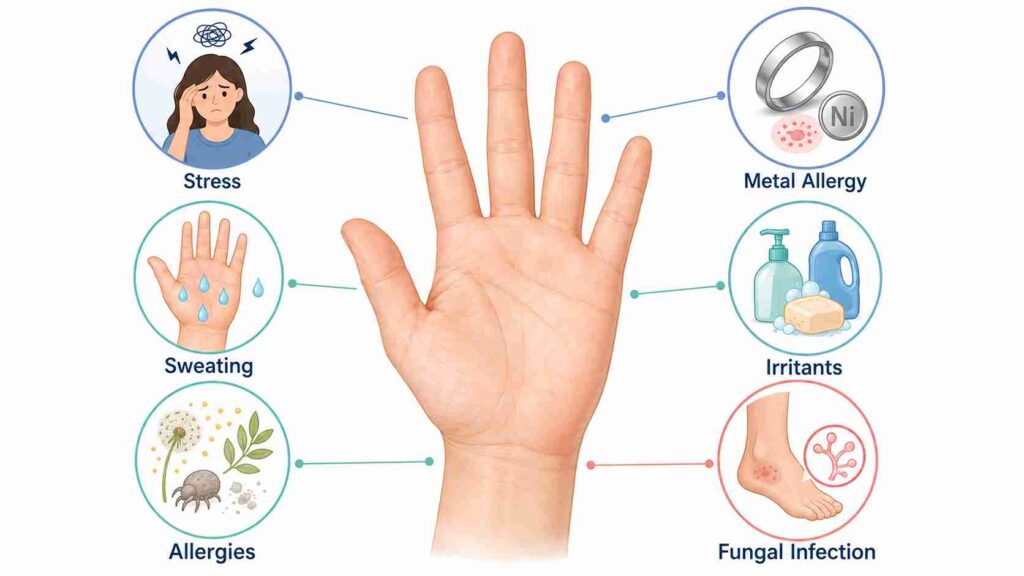
This is the most important section of this blog. The exact cause of dyshidrotic eczema is not fully understood, but there are several well-identified triggers that initiate or worsen flare-ups. Most people have one or two dominant triggers — finding yours is the key to getting lasting relief.
Our dermatology department at Kasturi Medical Centre routinely helps patients identify their specific triggers through clinical assessment and patch testing.
Cause 1: Emotional and Physical Stress
Stress is the single most commonly reported trigger.
When you are under pressure — work deadlines, family conflicts, anxiety — your body releases cortisol and inflammatory chemicals. These disrupt the skin's protective barrier. The result? A flare-up, sometimes days after the stressful event.
This delay is why many people miss the connection. The blisters appear and they think, "I haven't touched anything new." But the trigger happened earlier.
"The skin is the mirror of the mind. In dermatological practice, we consistently find that psychological stress precedes the majority of eczema flares — often by 48 to 72 hours." — Dr. Richard Fried, Clinical Psychologist and Dermatologist, Yardley Dermatology Associates
What to watch for:
- Flare-ups during or shortly after stressful periods
- Blisters that appear before major life events (exams, deadlines, family crises)
- Symptoms that improve when stress reduces
Cause 2: Metal Sensitivity — Nickel and Cobalt
Metal sensitivity is one of the most overlooked causes. It accounts for up to 30% of dyshidrotic eczema cases.
Nickel and cobalt can trigger blisters in two ways — through skin contact and through ingestion (eating foods that contain these metals). Many patients are shocked to learn that what they eat can directly cause palm blisters.
Common sources of nickel exposure:
| Contact Sources | Dietary Sources |
|---|---|
| Jewellery (rings, earrings, chains) | Oats and whole grains |
| Belt buckles and metal clasps | Chocolate and cocoa |
| Mobile phone casings | Nuts (cashews, peanuts, almonds) |
| Spectacle frames | Lentils and chickpeas |
| Coins handled frequently | Seeds (sunflower, sesame) |
| Keys held for long periods | Shellfish |
A patch test conducted by a dermatologist can confirm whether nickel or cobalt sensitivity is driving your flare-ups. If confirmed, a low-nickel diet alone has shown impressive results — one study found that 80% of patients with chronic nickel-related dermatitis achieved complete or near-complete recovery on a low-nickel diet.
Cause 3: Atopic History — Allergies, Asthma, and Eczema
If you already have a history of any of the following, your risk of dyshidrotic eczema is significantly higher:
- Atopic dermatitis (regular eczema)
- Hay fever or seasonal allergies
- Asthma
- Food allergies
This is called atopic predisposition. People with this background have an overactive immune system that responds more intensely to triggers. Environmental allergens like pollen, pet dander, or dust mites can trigger palm blisters — even without direct skin contact with the allergen.
This connection is why simply avoiding external irritants is sometimes not enough. The trigger is internal — your immune system is already primed to react.
Cause 4: Hot, Humid Weather and Excessive Sweating
Kolkata's climate is one of the most significant local risk factors for this condition.
Heat and humidity cause the palms to sweat more than usual. This excess moisture irritates the skin at a microscopic level and provokes blistering in susceptible individuals. Research consistently shows that dyshidrotic eczema is more prevalent in warmer climates and spikes during summer and monsoon months.
Many patients in our dermatology clinic in Behala report their worst flares between April and August — the hottest and most humid months in Kolkata.
Practical tip: Avoid keeping your hands damp for extended periods. Dry your hands thoroughly after washing. Use a lightweight, fragrance-free moisturiser immediately after drying.
Cause 5: Skin Irritants and Frequent Hand Washing
Repeated exposure to soaps, detergents, cleaning agents, sanitisers, and harsh chemicals strips the skin of its natural protective oils. Once the skin barrier is damaged, it becomes far easier for triggers to cause a reaction.
Occupations at highest risk:
- Healthcare workers (doctors, nurses, lab staff)
- Domestic helpers and cleaners
- Cooks and food handlers
- Hairdressers and beauticians
- Construction workers exposed to cement or chemicals
If your job involves frequent hand washing or chemical contact, this may be your dominant trigger — even if you have never thought of your work as a skin risk.
Cause 6: Fungal Infections — The Id Reaction
This cause surprises most patients. A fungal infection on your feet (athlete's foot or tinea pedis) can cause blistering on your hands — even when the hands are not directly infected.
This is called a dermatophytid reaction (or id reaction). It is an immune response to the fungal infection occurring elsewhere in the body. If you notice palm blisters coinciding with itchy, scaling feet, the connection may be exactly this.
The good news: treating the fungal foot infection typically resolves the hand blisters too. This is why a proper diagnosis matters. Treating palm blisters with steroid cream will not help if the real trigger is a fungal infection on your feet.
If you suspect a fungal issue alongside your skin problem, our diagnostic centre in Behala can run relevant tests to confirm it.
Cause 7: Contact Dermatitis
Direct skin contact with a specific allergen or irritant can produce blistering that closely resembles dyshidrotic eczema. Common culprits include rubber gloves, nail products, cosmetics, certain fabrics, and plant saps.
The distinction: contact dermatitis blisters appear precisely where skin touched the trigger, while dyshidrotic eczema is more generalised across the palm and fingers.
A patch test can identify your specific contact allergens. The National Eczema Society recommends patch testing as a key diagnostic step for recurring hand blisters with no obvious cause.
Who Is Most at Risk?
| Risk Factor | Details |
|---|---|
| Age | Most common in adults aged 20–40 |
| Family history | Eczema, asthma, or hay fever in the family increases risk |
| Occupation | Wet work, chemical exposure, repeated hand washing |
| Metal sensitivity | Confirmed nickel or cobalt allergy is a strong risk factor |
| Existing skin conditions | Atopic dermatitis or psoriasis increases susceptibility |
| Climate | Hot, humid conditions (especially tropical climates) increase frequency |
Is It Something Else? Conditions That Look Similar
Not every palm blister is dyshidrotic eczema. Getting the diagnosis right matters because the treatment is different for each condition.
| Condition | Key Difference | Contagious? |
|---|---|---|
| Contact Dermatitis | Blisters appear exactly where the trigger touched skin | No |
| Scabies | Intense itch (worse at night), burrow tracks between fingers | Yes |
| Bullous Impetigo | Yellow/cloudy fluid in blisters, honey-coloured crust after bursting | Yes |
| Hand-Foot-Mouth Disease | Accompanied by fever and mouth sores; common in children | Yes |
| Palmoplantar Psoriasis | Thick scaly plaques, not fluid-filled blisters | No |
| Tinea Manuum | Scaly ring-shaped rash, usually on back of hand | Mildly |
Important: Dyshidrotic eczema is not contagious. It cannot spread through touch, shared towels, or physical contact.
When to See a Doctor Immediately
Do not wait if any of the following apply:
- Blisters are large or spreading rapidly
- The fluid inside turns yellow or green (sign of bacterial infection)
- You develop fever or red streaks from the affected area
- The condition does not improve after 2–3 weeks
- It is significantly affecting your ability to use your hands
These are signs that the situation has moved beyond a routine flare-up and needs prompt medical attention.
Treatment and Management: What Actually Works
There is no permanent cure, but dyshidrotic eczema is very manageable with the right approach.
Medical treatments — prescribed by a dermatologist — include:
- Topical corticosteroids (e.g., clobetasol, betamethasone): First-line treatment. Reduces inflammation quickly. Must be used under medical supervision to avoid side effects.
- Topical calcineurin inhibitors (tacrolimus, pimecrolimus): Steroid-free alternatives for longer-term or sensitive-skin use.
- Oral antihistamines: Help control intense itching, especially at night.
- Phototherapy (PUVA or narrowband UVB): For moderate-to-severe or recurring cases. Administered over multiple sessions at a dermatology clinic.
- Antifungal treatment: If an id reaction is identified, treating the underlying fungal infection resolves the palm blisters.
- Systemic immunosuppressants: For severe, treatment-resistant cases — options include methotrexate, cyclosporine, or newer biologics.
At home:
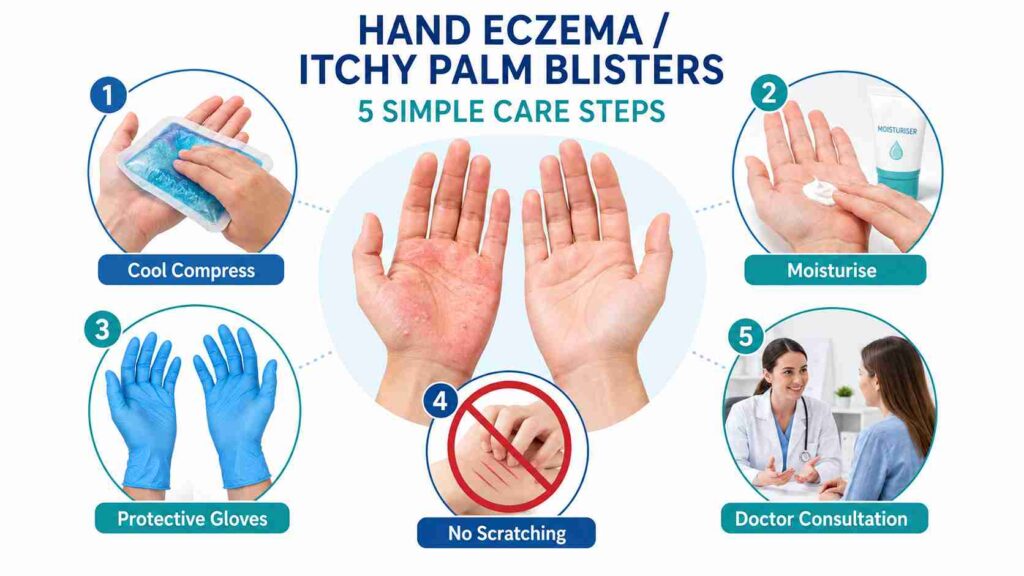
- Apply cool, damp compresses for 15–20 minutes to blistered areas several times a day
- Moisturise with a fragrance-free, thick emollient immediately after washing hands
- Wear nitrile or vinyl gloves (not latex) when handling cleaning products or chemicals
- Do not pop the blisters — this risks secondary bacterial infection
- Trim nails short and consider wearing cotton gloves at night to prevent scratching
Trigger management (the most underused tool):
Keep a simple diary for a few weeks. Note flare-ups alongside your diet, stress levels, weather, products used, and metals you contacted. Patterns usually become clear within a month. This information also helps your dermatologist design a much more personalised treatment plan.
Our dermatology team at Kasturi Medical Centre, provides patch testing, trigger identification, and evidence-based treatment plans for dyshidrotic eczema and all related skin conditions. You can also explore our healthcare packages or book an appointment directly.
Conclusion
If you keep getting itchy blisters on your palms and do not know why — this blog was written for you.
Dyshidrotic eczema is not random. It has causes. It has patterns. And in most cases, it has identifiable personal triggers that, once found, make the condition far easier to manage.
The most important steps are: get a proper diagnosis, identify your specific trigger (stress, metal, humidity, irritants, or fungal infection), and follow a consistent treatment and skincare routine. Do not let recurring flare-ups become your normal.
External references used in this article: